

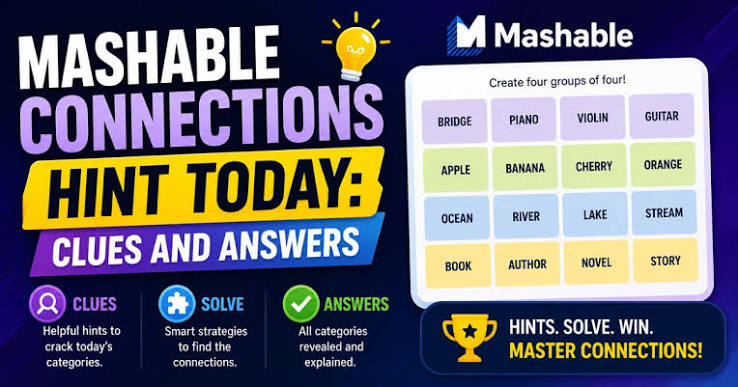
Looking for the connections answer mashable guide? You are probably trying to solve a tricky daily word puzzle. Connections looks simple at first. You get sixteen words and must arrange them into four groups.
The challenge comes from misleading clues. Several words can appear related. Only one combination usually fits the intended category.
Mashable-style puzzle coverage helps players understand those connections. It can also make difficult rounds less frustrating. This guide explains how the game works, how to use hints, and how to approach difficult categories without wasting guesses.
What Is Connections Answer Mashable?
Connections is a word association puzzle built around sixteen words. Players must divide those words into four groups of four.
Each group shares a hidden relationship.
That relationship could involve:
- Common phrases — words completing familiar expressions.
- Names and titles — words linked to people or works.
- Objects — items sharing a practical connection.
- Wordplay — clues connected through spelling or language.
The difficulty changes from one puzzle to another. Some categories are obvious. Others depend on unusual meanings.
That is why players often search for Mashable Connections answers and hints.
A useful guide should reveal the logic. It should not simply list four groups without explanation.
How the Mashable Connections Puzzle Works
The puzzle gives you sixteen clues. Your task is to identify four groups.
Each group contains exactly four words.
The categories usually have different difficulty levels. Color labels can help players understand that difficulty.
| Color | General Difficulty |
|---|---|
| Yellow | Usually easiest |
| Green | Moderate |
| Blue | More challenging |
| Purple | Usually hardest |
The colors do not tell you the answer. They simply indicate the expected difficulty.
The real challenge is spotting the intended relationship.
A word may fit several possible groups. That creates the puzzle’s famous traps.
The Best Way to Solve Connections
Do not immediately search for the strangest relationship.
Start with the obvious possibilities.
Look across all sixteen words first. Search for words that clearly belong together. Four strong matches can give you the first completed group.
After removing those words, the remaining clues become easier.
Start With Obvious Matches
Look for four words with a clear shared meaning.
For example, four words might describe types of weather, foods, sports, or household objects.
These groups are often easier to identify.
Watch for Double Meanings
Connections frequently uses words with multiple meanings.
A word can belong to one category literally. It may belong to another through a phrase or name.
This is where many incorrect guesses happen.
Before selecting a group, ask yourself one question:
Could one of these words belong somewhere else?
If yes, inspect the remaining clues again.
Think Beyond Literal Definitions
Some categories are based on phrases rather than definitions.
A clue might connect with another word to form a common expression. It may also relate to a title, name, brand, or cultural reference.
That makes vocabulary knowledge useful.
It also rewards flexible thinking.
Common Mistakes Players Make
Even experienced players can lose a round through one rushed guess.
Overlooking the Fourth Word
You may find three words that obviously connect.
That does not mean the category is correct.
Always identify the fourth word before committing.
Choosing a Category Too Broadly
Words can share broad concepts without belonging to the intended group.
For example, several clues may relate to travel. The actual category could be much narrower.
Look for the specific connection, not just a general theme.
Ignoring Alternative Meanings
A familiar word may have an uncommon use.
That alternative meaning can completely change the puzzle.
Consider names, verbs, adjectives, slang, and phrases.
Guessing Too Quickly
Wrong guesses reduce your available attempts.
Take a few seconds to compare competing groups.
A slower decision can save an entire puzzle.
How to Use Connections Hints Without Spoilers
Many players want help without seeing the complete answer.
Hints are useful for this reason.
A good hint should identify the category without immediately revealing every word.
For example, instead of showing four answers, a guide might say:
Hint: Think about words associated with cooking.
That gives players a direction.
They can still solve the group independently.
A spoiler-friendly format can also separate hints from answers. Readers who want the challenge can stop after the hint section.
Players seeking confirmation can continue to the solution.
Why Connections Has Become So Popular
The appeal comes from its simplicity.
You do not need a long gaming session. One puzzle can be completed relatively quickly.
Yet the game still creates meaningful mental challenges.
Players must recognize patterns. They must compare meanings. They must reject tempting but incorrect relationships.
The social element also helps.
People can discuss their results without immediately explaining every category. That creates friendly competition among friends, families, and online communities.
Daily puzzles also encourage a routine.
Players return because tomorrow brings a completely different set of clues.
Connections Answer Mashable Search Intent
People searching for connections answer mashable usually want one of several things.
Some want the complete solution. Others only need a hint.
Some players want to understand why their answer was wrong.
That makes a useful article more than an answer list.
The strongest guides should explain the reasoning behind each category. They should also help readers improve their solving technique.
That approach provides value even after the daily puzzle changes.
Tips for Solving Difficult Connections Puzzles
When a puzzle feels impossible, change your approach.
Do not stare at one group for too long.
Move around the board.
Scan Every Word
Read all sixteen clues before making a choice.
Your first impression may be misleading.
Find Strong Pairs
Two related words can reveal a larger category.
Look for additional words that share the same relationship.
Test Four Together
A category should explain all four words naturally.
If one word feels forced, reconsider the group.
Use Elimination
Once one group disappears, the remaining clues become more manageable.
Elimination is especially powerful during difficult rounds.
Save the Hardest Category
The final group often becomes easier after other words are removed.
Do not assume the purple group is impossible.
Sometimes it simply needs fewer distractions.
Final Thoughts on Connections Answer Mashable
The best way to approach Connections is with patience.
The puzzle rewards observation more than speed. Strong players look for precise relationships. They also question their first assumptions.
If you use Mashable-style hints, try solving the category yourself first. Reveal the full answer only when you genuinely need it.
That keeps the puzzle challenging while still giving you a useful safety net.
Whether you play every morning or occasionally, the same principle works: look for patterns, question obvious matches, and use elimination wisely.
Quick Lessons
- Scan first: Read every clue before guessing.
- Check meanings: Words can have multiple uses.
- Avoid traps: Three matches do not guarantee four.
- Use elimination: Remaining clues often reveal harder groups.
Read more:Sue Aikens Husband Michael Heinrich: The Real Story